
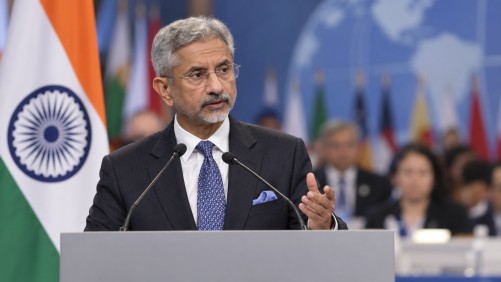
External Affairs Minister S. Jaishankar has highlighted that the waning respect for international rules is leading to new “choke points” in global affairs. Speaking at an Asia Society event in New York, Jaishankar emphasized that strategic waterways, financial systems, and market access are becoming increasingly leveraged points by countries to exert influence over competitors and adversaries.
Jaishankar pointed to the Strait of Hormuz as a geographical choke point, underscoring the strategic importance of such locations in international relations. Additionally, he noted that financial restrictions, often imposed through sanctions, and limitations on travel and market access are being wielded as tools of leverage by nations with significant power.
The minister also discussed the growing tension between competition and interdependence among countries. He explained that, while nations are vying for strategic and economic dominance, their economies and supply chains remain deeply interconnected, adding layers of complexity to diplomatic efforts.
This dual nature of competition and interdependence, according to Jaishankar, poses challenges for diplomacy. Governments are tasked with the delicate balancing act of pursuing competitive advantage while managing practical constraints imposed by their intertwined economic and political relationships.
Jaishankar’s insights reflect the increasingly complex landscape of international diplomacy, where strategic rivalries must be navigated alongside enduring economic and political ties. This evolving dynamic calls for nuanced diplomatic strategies that account for both competition and interdependence in global affairs.