
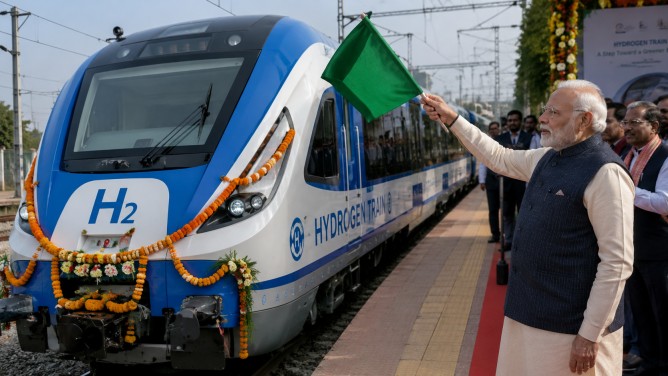
India has taken a substantial leap in sustainable transportation with the launch of its first hydrogen fuel cell-powered train. This pioneering effort was inaugurated by Prime Minister Narendra Modi in Jind, Haryana, symbolizing the nation’s commitment to adopting cleaner energy solutions in its rail network.
The ambitious project encompasses a comprehensive hydrogen production system, a specialized refuelling station, and a locomotive powered by fuel cells. Hydrogen is generated on-site using an electrolyzer before being compressed, stored, and delivered to the train at a dedicated refuelling station equipped with high-pressure compressors and hydrogen dispensers. This setup also includes an automated fuel management platform that ensures efficient and safe operations during the refuelling process.
This development underscores India’s advancing capabilities in building indigenous hydrogen infrastructure, aligning with the objectives of the National Green Hydrogen Mission. Plans are underway to extend similar hydrogen refuelling systems to heritage railway routes like the Darjeeling Himalayan Railway, Kalka-Shimla Railway, and Nilgiri Mountain Railway, further promoting eco-friendly transport solutions.
Hydrogen fuel cell trains are celebrated for their environmentally friendly technology, generating electricity by combining hydrogen with oxygen and emitting only water vapor as a byproduct. As a cleaner alternative to diesel-powered trains, they are poised to significantly contribute to reducing carbon emissions in the transportation sector.