
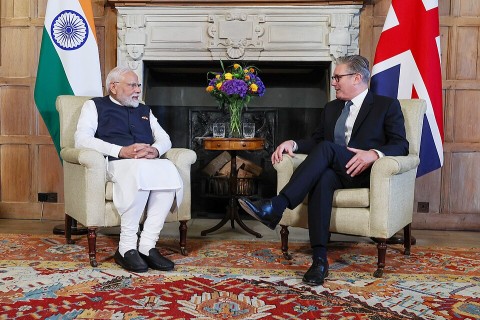
In a pivotal diplomatic achievement, Keir Starmer, the outgoing British Prime Minister, played a crucial role in finalizing the India-UK Free Trade Agreement (FTA) before stepping down from his role. The agreement was cemented during a meeting with Indian Prime Minister Narendra Modi at the G7 Summit in 2026, where both leaders set July 15 as the start date for the India-UK Comprehensive Economic and Trade Agreement (CETA). This deal is poised to significantly enhance the trade relationship between the two nations, which currently stands at approximately £48 billion annually.
Starmer, a staunch advocate for strengthening ties with India, had made the trade agreement a cornerstone of his administration’s objectives. He described the CETA as a significant opportunity for economic expansion, emphasizing India’s growing global economic influence and the advantages of more streamlined and cost-effective trade between the two countries. His efforts were part of a broader strategy to foster deeper connections with India, which included commitments to enhance collaboration in areas such as trade, security, education, technology, and climate change.
Since taking leadership of the Labour Party after its 2019 electoral defeat, Starmer worked diligently to rebuild relations with the British Indian community. His leadership saw Labour winning a landslide victory in the 2024 elections, which elevated him to the position of Prime Minister. Before his political career, Starmer was renowned for his legal expertise, having served as the Director of Public Prosecutions. Despite early successes in stabilizing the UK’s economy and initiating domestic reforms, Starmer’s tenure faced multiple challenges, which eventually eroded his political standing.
In a heartfelt resignation speech, Starmer acknowledged the loss of confidence among members of his parliamentary party, who felt he was no longer suited to lead Labour into the next general election. Accepting their decision with respect and gratitude, Starmer’s announcement marked the conclusion of a notable chapter in British politics. His departure comes after a tenure characterized by both significant achievements and formidable challenges, leaving a lasting impact on the UK’s diplomatic and domestic landscape.