
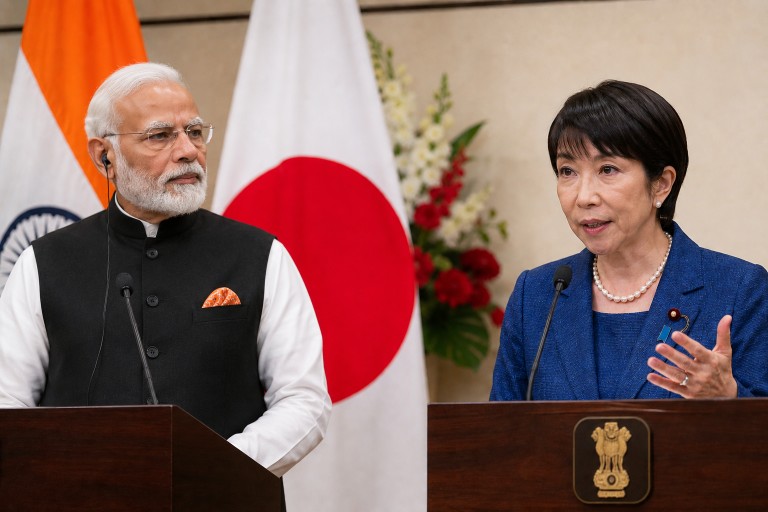
Prime Minister Sanae Takaichi of Japan recently found herself addressing an unexpected translation error during a joint press conference with Indian Prime Minister Narendra Modi in New Delhi. The mix-up occurred on July 2, when Takaichi mistakenly referred to Modi’s description of her as his “beautiful sister.” This mistake was clarified by the Japanese government, which explained that the error stemmed from a complex translation process involving multiple languages.
The original statement by Modi, spoken in Hindi, simply referred to Takaichi as “my sister.” However, an official English translation rendered it as “my younger sister.” During the subsequent relay interpretation from Hindi to English and finally into Japanese, the phrase was inaccurately translated as “beautiful sister.” As a result, Takaichi, believing this to be accurate, repeated the term during their public address, mentioning that she and Modi had agreed to nurture a relationship akin to that of siblings.
Japanese officials have since elucidated that this translation mishap was a byproduct of the inherent challenges associated with simultaneous relay interpretation. This kind of interpretation requires the conversion of spoken words through multiple languages in real-time, which can sometimes lead to such inaccuracies. Despite the error, the officials assured that the incident had no adverse effects on diplomatic ties between Japan and India.
India has shown no concern over the mistranslation, signaling that the friendly relations between the two nations remain intact. Both countries continue to emphasize their commitment to maintaining a strong and cooperative partnership, underscored by the camaraderie demonstrated by Takaichi and Modi during their encounter.